
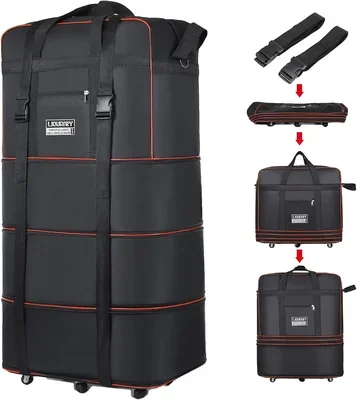
Shopping for luggage used to be straightforward. You picked a size, chose a color, and hoped the zipper didn’t bust before you reached baggage claim. Today, the game has changed. The rise of expandable foldable luggage has introduced a brilliant paradox: a suitcase that grows when you need space and shrinks when you don’t. It sounds like magic, but like any travel gear, the devil is in the details. This guide exists because not all expandable foldable bags are created equal. Some are engineering marvels that last a decade; others are frustrating flimsy boxes that collapse under the weight of a weekend wardrobe.
Over the next several thousand words, we are going to break down everything you need to know to buy with total confidence. We will translate technical specs into plain English, compare the major categories side-by-side, expose the common traps that catch unwary buyers, and give you a clear budget roadmap. Whether you are a chronic over-packer trying to avoid checked bag fees, a digital nomad living out of a single carry-on, or a family traveler needing maximum flexibility, this guide will help you match the right bag to your specific travel style. Let’s unpack this together.

What to Look for When Buying Expandable Foldable Luggage
Before you fall in love with a color or a brand logo, you need to understand the mechanics that make these bags work. The “expandable” and “foldable” mechanisms are moving parts, and moving parts are where durability lives or dies. Prioritize these factors in this order; the first three are non-negotiable for a good experience.
1. Expansion Mechanism Integrity
This is the heart of the product. Most expandable luggage uses a zippered gusset—a hidden panel of fabric that unfolds when you unzip it, adding anywhere from 1.5 to 3 inches of depth. The critical question is: how is that gusset attached? Look for reinforced stitching at the stress points (the corners of the expansion zipper). Cheap bags use a single row of stitching that pops after two trips. Quality bags use bar-tacking or double-needle stitching with heavy-duty thread.
Also, test the zipper itself. It should be a large-gauge coil zipper (size #8 or #10), not the tiny zippers found on clothing. YKK is the gold standard brand, but other reputable brands like SBS or IDEAL work well if the teeth are substantial. The zipper pull should be large enough to grab with cold or gloved hands. If the expansion zipper feels “grindy” or catches on the fabric in the store, walk away. It will only get worse under the tension of a fully packed bag.
2. Foldability and Storage Profile
“Foldable” means different things to different brands. For some, it means the bag collapses flat enough to slide under a bed (2-3 inches thick). For others, it means the frame collapses but the wheels and handle mechanism still leave a 6-inch lump. If you live in a small apartment or have limited closet space, the folded dimensions are a spec you must check before buying.
There are two main folding architectures: Soft-sided fold-flat (the frame is removable or flexible, allowing the bag to become a pancake) and Frame-fold (a rigid frame hinges in the middle). Soft-sided bags pack smaller but offer less structure when expanded. Frame-fold bags hold their shape better but store thicker. Decide which trade-off fits your storage reality.
3. Wheel System: Spinner vs. Inline vs. Hybrid
Wheels take the most abuse. On expandable luggage, the weight distribution shifts dramatically when you expand the bag. A bag that rolls perfectly at 22 inches deep might become tippy and unstable at 25 inches deep.
- Four-wheel Spinners (360°): Best for smooth airports and flat hotel floors. They allow you to push the bag beside you. However, on cobblestones, gravel, or cracked sidewalks, small spinner wheels can jam. Look for larger diameter wheels (3 inches+) and sealed ball bearings. “MagnaSpinner” or “Hinomoto” (Japanese) wheels are top-tier indicators.
- Two-wheel Inline (Roller): Better for rough terrain, curbs, and stairs. They are recessed into the body, protecting them from baggage handlers. The downside: you must tilt and pull. On a heavy expanded bag, this strains your wrist.
- Hybrid/Convertible: Some new models offer recessed spinners that function as both. These are excellent but add weight and complexity.
Check the wheel housing. Is it riveted through the shell (hard to repair) or bolted into a reinforced corner block (replaceable)? Replaceable wheels extend the bag’s life by years.
4. Handle System: Telescoping and Carry Handles
The telescoping handle (trolley handle) is your steering wheel. It needs to lock securely at multiple heights (usually 2-3 stops) to accommodate different user heights. A handle that slides down while you’re running for a connection is infuriating. Grip the handle and shake the bag vigorously in the store. Any wobble or rattle at the connection point to the bag body is a red flag.
Materials matter: Aircraft-grade aluminum tubes are lighter and stronger than steel. Carbon fiber is the lightest but can shatter on severe impact. The grip material should be tacky rubber or silicone, not smooth hard plastic, which gets slippery with sweaty hands.
Don’t ignore the top and side carry handles. When you lift an expanded 40-lb bag into an overhead bin or a trunk, those handles take the full load. They must be riveted or bolted through the shell/frame, not just stitched to the fabric. Look for padded, contoured grips.
5. Shell Material: Hard-Side vs. Soft-Side vs. Hybrid
This choice dictates weight, protection, and how the expansion works.
- Polycarbonate (Hard-side): The modern standard. It flexes under impact rather than cracking (unlike ABS or ABS/PC blends). It is water-resistant and easy to clean. Expansion on hard-sides is usually a zippered gusset that pushes the two shell halves apart. It looks sleek but shows scratches.
- Ballistic Nylon / Cordura (Soft-side): The classic choice. Extremely abrasion-resistant. Expansion is inherent—the fabric just stretches. Soft-sides often have external pockets (great for quick access) and can squeeze into tight overhead bins better than rigid hard-sides. They absorb water unless treated with a DWR (Durable Water Repellent) coating.
- Hybrid (Frame + Fabric): A rigid frame (often aluminum or fiberglass) covered in high-denier fabric. Offers the structure of hard-side with the pocket flexibility of soft-side. Often the heaviest option.
Denier (D) Rating: You’ll see 600D, 1680D, etc. This measures fiber thickness. Higher isn’t always better; 1680D ballistic nylon is tougher than 1680D polyester. Ballistic nylon (originally for flak jackets) is the toughness benchmark. Cordura is a brand name for high-tenacity nylon, also excellent.
6. Internal Organization & Compression
An expanded bag is a cavern. Without organization, it becomes a jumbled mess. Look for:
- Compression straps: Essential. They cinch down the contents so clothes don’t shift during transit (which wrinkles them) and so the expansion zipper isn’t fighting internal pressure.
- Divider panel: A zippered mesh divider between the two halves keeps dirty laundry separate from clean, or shoes away from shirts.
- Mesh pockets: On the divider and lid. Great for chargers, toiletries, underwear.
- Suiter system: A dedicated padded sleeve or folder for a suit/dress. If you travel for business, this is a must-have.
7. Weight and Airline Compliance
Every ounce of luggage weight is an ounce less you can pack. Airlines are strict. Most US domestic carry-on limits are 22″ x 14″ x 9″ (including wheels/handles). International limits are often smaller (21.5″ x 15.5″ x 9″ or less) and weight-restricted (often 7kg / 15lbs).
An expandable carry-on is a trap if you expand it at home. It will not fit the sizer at the gate. The expansion is for the return trip (souvenirs, dirty laundry bulk) or for checked luggage. If buying a carry-on, verify the unexpanded dimensions comply with your most restrictive airline. For checked bags, the 62 linear inches (L+W+H) limit applies. A large expanded check-in bag can easily exceed this.
8. Warranty and Repairability
A warranty tells you how long the manufacturer expects the bag to last. “Lifetime warranty” sounds great, but read the fine print. Does it cover airline damage? (Most don’t). Does it cover zippers and wheels? (The parts that actually break). Does the company have a repair center in your country, or do you pay shipping both ways to a central depot?
Brands like Briggs & Riley, Travelpro, and Osprey have stellar reputations for honoring warranties and stocking parts. A 10-year warranty from a no-name Amazon brand is usually worthless—the company won’t exist in three years. Repairability is the hidden gem: Can you buy a replacement wheel for $15 and install it with a screwdriver? Or is the wheel riveted in, requiring a $200 repair shop visit?
Different Types of Expandable Foldable Luggage

Common Buying Mistakes to Avoid
❌ Mistake: Buying Based on “Expanded Capacity” Liters Alone
Why it’s bad: Manufacturers love to advertise “Expands to 45L!” What they don’t highlight is the base capacity (maybe 32L) and the weight of the bag itself (maybe 9 lbs). If the bag weighs 9 lbs empty, you have only 6 lbs left for a 15 lb international carry-on limit. You’ve lost the game before you packed a sock.
What to do instead: Prioritize empty weight and base dimensions. Calculate your “usable payload” = (Airline Weight Limit) – (Bag Empty Weight). If that number is under 10 lbs for a carry-on, the bag is too heavy for practical expansion use.
❌ Mistake: Ignoring the “Expanded Dimensions” for Carry-On
Why it’s bad: You buy a carry-on that expands 2 inches. You pack it expanded for your return flight. You get to the gate. The agent puts it in the sizer. It doesn’t fit. You gate-check it. You pay $35-$60. Your fragile items get crushed.
What to do instead: Treat the expansion zipper as a return-trip feature only. Pack the bag unexpanded going out. If you must expand for the return, be prepared to gate-check or ensure your airline allows slightly oversized bags (rare). Better yet, buy a separate cheap fold-flat duffel for overflow.
❌ Mistake: Choosing Spinner Wheels for Cobblestones and Gravel
Why it’s bad: Four tiny 1.5-inch spinner wheels are amazing on linoleum. On European cobblestones, dirt paths, or snowy sidewalks, they dig in, snap off, or fill with debris. You end up carrying a 25-lb bag.
What to do instead: Match wheels to terrain. If 80% of your travel is smooth airports/hotels: Spinners. If you do adventure travel, European city breaks, or rural areas: Two-wheel inline with large (3″+) polyurethane wheels, or a hybrid bag you can carry as a backpack.
❌ Mistake: Assuming “Lifetime Warranty” Means “No Questions Asked”
Why it’s bad: Many “lifetime” warranties cover only “defects in materials and workmanship.” Airline damage (crushed corners, torn wheels) is explicitly excluded. Some require you to register within 30 days. Some charge a “processing fee” that equals half the bag’s value.
What to do instead: Read the warranty PDF before buying. Look for: “Covers airline damage,” “No registration required,” “Free repair parts,” “Repair centers near me.” Brands like Briggs & Riley (lifetime, covers airline damage) and Osprey (All Mighty Guarantee) set the standard.
❌ Mistake: Overlooking Internal Compression Straps
Why it’s bad: You pack the bag full, expand it, zip it up. Inside, clothes shift. The center of gravity moves. The bag tips over constantly. Wrinkles set deep because fabric rubs against fabric under pressure.
What to do instead: Never buy an expandable bag without adjustable compression straps (ideally two per compartment, crossing in an X). They are the only thing keeping your expanded load stable and wrinkle-free.
❌ Mistake: Buying a “Set” When You Only Need One Piece
Why it’s bad: Luggage sets (3-piece, 5-piece) look like a deal. Usually, the carry-on is great, the medium is okay, and the large is a flimsy, heavy box you’ll never use because it exceeds weight limits when half-full. You pay for three bags, use one, store two.
What to do instead: Buy individual pieces (“open stock”) tailored to each trip type. A premium carry-on + a cheap fold-flat duffel for overflow beats a mediocre 3-piece set every time.
❌ Mistake: Neglecting the “Personal Item” Pairing
Why it’s bad: You buy a beautiful expandable carry-on. It has no rear trolley sleeve (the strap that slides over your rolling bag’s handle). You also carry a laptop backpack. You now have two hands occupied. You cannot pull the rolling bag and wear the backpack comfortably (the straps slip).
What to do instead: Ensure your rolling luggage has a rear trolley strap / piggyback strap. Ensure your backpack/briefcase has a matching pass-through sleeve. Test them together in the store. This “system” approach saves your shoulders.
Budget Guidelines: How Much Should You Spend?
Price correlates strongly with wheel quality, handle rigidity, fabric denier, and warranty support. Here is what you realistically get at each tier.
Entry-Level ($50 – $120)
What you get: Basic polycarbonate (often ABS blend) or 600D-900D polyester. Two-wheel inline or basic spinners with plastic bushings (no ball bearings). Single-stage trolley handle. Minimal internal organization. Expansion zipper is usually #5 coil, prone to snagging. Warranty: 1-2 years limited, rarely honored internationally.
Best for: Occasional leisure travelers (1-2 trips/year), kids’ luggage, “beater” checked bags you don’t mind getting scuffed. Avoid for frequent flyers or heavy packers—the wheels and handles will fail within 24 months.
Mid-Range / Sweet Spot ($150 – $300)
What you get: Genuine Polycarbonate (Makrolon/Bayer or Covestro) or 1680D Ballistic Nylon / Cordura. Hinomoto or equivalent Japanese spinner wheels with sealed bearings. Multi-stage aluminum trolley handle with ergonomic grip. YKK or SBS #10 expansion zippers. Full internal organization (compression straps, divider, pockets). 5-10 year or “Limited Lifetime” warranty with accessible service centers.
Best for: 90% of travelers. This is the “buy once, cry once” zone. Brands: Travelpro (Platinum Elite, Maxlite), Briggs & Riley (Baseline – often on sale), Samsonite (Freeform, Omni PC), Osprey (Rolling Transporter), Delsey (Chatelet Air 2.0). You get repairable parts and materials that handle weekly travel.
Premium ($300 – $600)
What you get: Advanced materials: Tegris (thermoplastic composite), Curv (woven polypropylene), or Aerospace-grade Aluminum frames. Precision engineering: silent wheels, zero-wobble handles, magnetic catches, integrated TSA locks with USB ports (power bank not included), removable washable liners. Expansion mechanisms are often structural (frame expands) not just fabric. Warranty: True Lifetime, often covering airline damage (Briggs & Riley, Rimowa Essential, Tumi).
Best for: Road warriors (50+ flights/year), travelers with back/shoulder issues (lightest weight + best balance), those who want a “forever bag” and appreciate design details. The weight savings alone (often 1.5-2 lbs lighter than mid-range) justifies the cost for frequent flyers.
Luxury / Heritage ($600 – $1,500+)
What you get: Rimowa (Original/Classic), Globe-Trotter, Tumi (19 Degree Aluminum), Briggs & Riley (Torq). Hand-assembled. Anodized aluminum or vulcanized fiberboard shells. Leather accents. Serial numbers. Concierge repair service (they pick up/deliver). These are heirlooms. The expansion on aluminum Rimowa is a mechanical marvel—interlocking grooves, no zipper to break.
Best for: Buyers for whom luggage is a lifestyle statement, collectors, or those who value the absolute pinnacle of repairability (Rimowa replaces dents; Globe-Trotter re-corners). Diminishing functional returns vs. Premium tier; you pay for brand, heritage, and service experience.
Expert Tips for Getting the Best Deal
- Time your purchase: Best sales: January (post-holiday clearance), May (Memorial Day), July (Amazon Prime Day / Summer travel prep), November (Black Friday / Cyber Monday). Worst time: June (peak summer travel launch, full MSRP).
- Check “Open Box” / “Refurbished” at Major Retailers: REI, Backcountry, Briggs & Riley factory outlet, Travelpro outlet. Returns are often just “wrong color” or “too big.” They are inspected, warrantied, and 20-40% off.
- Use the “Two-Bag Rule” for Carry-On: Don’t buy the biggest carry-on allowed. Buy the international standard (approx 21.5″ x 13.5″ x 9″). It fits every overhead bin (including regional jets and European budget airlines). The 22″ US domestic max gets gate-checked on small planes constantly.
- Register Immediately: If the brand requires registration for warranty (Travelpro, Samsonite, Briggs & Riley), do it the day you receive the bag. Take photos of the serial number tag (usually inside near the handle tube). Save the receipt PDF. This takes 3 minutes and saves headaches later.
- Test the “Wobble Factor” Before Checkout: Whether in-store or upon delivery: Extend handle fully. Load bag with 15-20 lbs (books, water jugs). Roll it on carpet, hard floor, and a threshold (simulate a curb). Push it, pull it, spin it. If it tips, rattles, or the handle flexes alarmingly, return it. Do not keep a bag that annoys you on day one.
- Invest in a Luggage Scale: A $10 digital scale saves $50+ overweight fees. Weigh your packed bag before you leave for the airport. Shift items to your personal item if needed.
- Protect Your Investment: Buy a clear vinyl luggage cover ($15) for checked bags. It prevents scratches, keeps the expansion zipper from snagging on conveyor belts, and makes your black bag instantly identifiable on the carousel.
- Know Your Credit Card Benefits: Many premium cards (Chase Sapphire Reserve, Amex Platinum, Capital One Venture X) offer baggage insurance (lost/damaged) and sometimes purchase protection on the luggage itself. Pay with the right card.

Frequently Asked Questions
Q: Can I use the expansion feature on a carry-on for my outbound flight?
A: Technically yes, but strategically no. If you expand a carry-on, it almost certainly exceeds the airline’s published size limits (usually 22″ x 14″ x 9″ including wheels). You risk forced gate-checking (fees + risk of damage/loss). Use expansion only for the return trip (souvenirs, bulky dirty laundry) or if you are certain your airline/aircraft allows oversized carry-ons (rare). Pack a fold-flat duffel inside your carry-on for emergency overflow instead.
Q: Do hard-side suitcases expand less than soft-side?
A: Generally, yes. Hard-side expansion is limited by the zippered gusset depth (usually 1.5″ – 2.5″). Soft-side bags can sometimes expand more because the fabric itself has give, and the gusset can be deeper. However, soft-sides bulge unpredictably, potentially exceeding linear inch limits even if the “frame” fits. Hard-sides expand in a controlled, boxy shape, making it easier to judge if they’ll fit a sizer.
Q: Are foldable luggage durable enough for checked baggage?
A: It depends entirely on the frame architecture. Cheap fold-flat bags with plastic frames or no frames will crush under the weight of other bags in the cargo hold. Look for “Frame-Fold” or “Hybrid” checked luggage with aluminum or fiberglass frames that lock rigidly into place. These are rated for checked baggage. Soft fold-flat duffels (packable totes) should never be checked unless they are inside a protective box/bag—they offer zero structural protection.
Q: How do I clean expandable foldable luggage?
A: Hard-side: Wipe with damp microfiber cloth + mild soap (dish soap). For scuffs, use a magic eraser (melamine foam) gently. Soft-side: Vacuum interior. Spot clean exterior with soft brush + mild detergent (Nikwax Tech Wash or Grangers). Do not machine wash—it destroys waterproof coatings and frame integrity. Wheels: Clean hair/debris from axles with tweezers. Lubricate bearings annually with PTFE (Teflon) dry lube spray—NOT WD-40 (attracts dirt).
Q: What does “Denier” mean and what number should I look for?
A: Denier (D) is the weight in grams of 9,000 meters of the fiber. Higher = thicker fiber. But material type matters more than number. 1000D Nylon > 1680D Polyester in tear strength. Look for Ballistic Nylon (usually 1680D or 1050D) or Cordura (1000D+). These are the gold standards for abrasion resistance. Avoid “Oxford cloth” or plain “Polyester” without a denier spec—it’s usually low quality.
Q: Is it worth paying for a built-in USB charging port?
A: Usually no. The port is just a pass-through cable inside the bag. You still need to buy and carry your own power bank. The cable adds a failure point (frays at the hinge) and the port cover breaks off. TSA requires you to remove the power bank for screening anyway. Better: Buy a dedicated power bank with short, right-angle cables. Keep it in an external pocket. Skip the gimmick.
Q: How do I fix a stuck expansion zipper?
A: Do not force it. Zipper teeth misalign under tension. 1) Empty the bag partially to relieve tension. 2) Use a graphite pencil (rub lead on teeth) or zipper lubricant (Gear Aid Zipper Lubricant). 3) Gently wiggle the pull tab side-to-side while pulling slowly. 4) If fabric is caught, use tweezers to free it. Prevention: Never overstuff the expansion. Leave 10% air space. Keep zipper tracks clean.
Q: Can I replace wheels myself?
A: On mid-range and premium bags: Yes, often. Brands like Travelpro, Briggs & Riley, Osprey, and Samsonite sell wheel kits ($15-$30/pair). You need a screwdriver (Phillips/Torx) and 10 minutes. On budget bags: Wheels are usually riveted. Drilling out rivets and bolting new wheels is possible but requires tools/skill. Check the brand’s website for “Parts & Repair” before buying—if they don’t sell wheels, assume you can’t replace them.
Q: What’s the difference between “Spinner” and “MagnaSpinner” / “Hinomoto”?
A: “Spinner” is a generic term for 360° wheels. Hinomoto is a specific Japanese manufacturer famous for the “Lisof” silent wheel—precision sealed bearings, polyurethane tread, exceptional durability. MagnaSpinner is a branding term (often used by Travelpro) for their Hinomoto-sourced wheels. If you see “Hinomoto” or “Lisof” in specs, it’s a high-quality wheel. Generic “spinner wheels” on a $80 bag are likely plastic bushings that will grind and wobble within a year.
Q: Should I buy a luggage set or individual pieces?
A: Almost always individual pieces (“open stock”). Sets force you to buy sizes you don’t need (usually a too-large checked bag) and compromise quality on the pieces you do use. Mix and match: Premium carry-on (you use it most) + Budget checked bag (takes the beating) + Packable duffel (for overflow). You spend the same or less for a better system.
Our Final Recommendations
Based on the factors, types, and budgets discussed, here are our top picks for specific


