
Shopping for luggage used to feel like a chore, something you did quickly at a department store before a trip. But if you travel even semi-regularly, you know that your suitcase is more than a container—it is your mobile closet, your gear protector, and sometimes your seat while waiting in a delayed flight line. The market has exploded with options, and the term “expandable hard shell luggage set” gets thrown around on product pages like a magic phrase. It promises durability, organization, and that sweet extra 15 to 25 percent packing space when you inevitably buy too many souvenirs.
This guide exists because not all hard shells are created equal. A $150 three-piece set behaves very differently from a $600 set after two checked-bag throws onto a conveyor belt. We are going to cut through the marketing fluff. By the time you finish reading, you will understand the difference between polycarbonate and ABS, why spinner wheel construction matters more than wheel count, and how to spot a warranty that actually protects you versus one that sounds good on the box. Whether you are a weekend warrior, a family vacation planner, or a road warrior chasing status, this breakdown will help you buy once and buy right.
The current market is split into three distinct tiers: budget-friendly brands fighting on price, mid-range workhorses balancing features and longevity, and premium legacy brands selling heritage and repair networks. We will look at all of them. We will talk about size strategies—why buying the biggest set isn’t always smart—and the hidden costs of “lightweight” construction. Let’s get your next trip started on the right foot.

What to Look for When Buying Buying Guide
1. Shell Material: The Science of Survival
This is the single most important factor. The shell takes the abuse so your clothes don’t have to. You will see three main materials: Polycarbonate, ABS (Acrylonitrile Butadiene Styrene), and blends marketed as “PC/ABS” or “Composite.”
Polycarbonate (PC) is the gold standard for a reason. It is flexible. When a baggage handler drops your bag from a belt loader, polycarbonate flexes on impact and snaps back to shape. It resists cracking in cold cargo holds and handles heat in a car trunk. It is more expensive to mold, which is why it dominates the mid-range and premium tiers.
ABS is rigid and brittle. It is cheaper to manufacture. It looks shiny and hard in the store, but a sharp impact—especially in freezing temperatures—can cause it to spider-web crack or shatter. You mostly find pure ABS in entry-level sets under $150.
PC/ABS Blends are the middle ground. They offer better impact resistance than pure ABS at a lower cost than 100% polycarbonate. If you are buying in the $180–$300 range, this is likely what you are getting. It is a perfectly viable choice for leisure travelers who check bags 2–3 times a year.
2. Wheel Architecture: Spinners vs. Inlines, and Why Bearings Matter
Four-wheel spinners (360-degree rotation) are now the default, and for good reason. They let you push the bag beside you down a narrow airplane aisle or pull it effortlessly through a terminal. Two-wheel inlines are more durable on rough pavement—cobblestones, cracked sidewalks, gravel—because the wheels are recessed into the body and larger in diameter.
But the number of wheels matters less than the wheel housing and bearing quality. Cheap spinners use a plastic rivet or screw holding a plastic wheel to a plastic housing. One hard hit on a curb snaps the housing, and the wheel wobbles or falls off. Premium bags use double-ball-bearing wheels mounted on a metal axle that is recessed into a reinforced corner bracket.
Look for Hinamoto or YKK branded wheels, or at minimum “double spinner wheels” with a visible metal axle pin. Single-wheel spinners on budget sets are a failure point waiting to happen. Also, check the wheel diameter. Larger wheels (3 inches+) roll over thresholds and carpet seams better than tiny 1.5-inch wheels.
3. Handle System: The Telescoping Mechanism
The handle is your steering wheel. A wobbly, sticky, or bent handle turns a smooth walk into a wrestling match. There are two main designs: the single-tube (monopole) and the double-tube (dual-pole).
Double-tube handles are inherently more stable. They distribute torque across two aluminum tubes, reducing side-to-side wobble. They also usually offer more height adjustments (3–4 stops), which is critical if you are very tall or short. Single-tube handles are lighter and allow a flatter interior floor (no tubes intruding into packing space), but they flex more under heavy loads.
Test the action: it should extend and retract with a smooth, dampened “thunk,” not a rattling clang. The grip material matters too—rubberized or gel grips absorb vibration from rough pavement; hard plastic grips transmit it straight to your wrist.
4. Expansion Mechanism: Gusset Depth and Zipper Quality
This is the namesake feature. Expansion works via a zippered gusset—a folded panel of fabric hidden between the shell halves. When unzipped, the gusset unfolds, adding 1.5 to 2.5 inches of depth.
Two things determine if this feature lasts: the zipper and the gusset fabric. Expansion zippers take immense tension when the bag is stuffed. You need a #10 (heavy-duty) coil zipper, ideally from YKK or SBS, with large, easy-to-grip pulls. Cheap #5 zippers will burst teeth or split the tape within a few trips.
The gusset fabric should be high-denier ballistic nylon or at least 1680D polyester. Thin 300D polyester gussets tear at the corners where the zipper meets the shell. Also, check if the expansion is full-perimeter (goes all around) or partial (only front/back). Full perimeter gives more volume but stresses the frame more; partial is structurally stronger but adds less space.
5. Interior Layout: Compression, Dividers, and Pockets
A pretty shell with a blank interior forces you to buy packing cubes. A smart interior saves you money and keeps clothes wrinkle-free. Look for:
- Compression Straps: X-straps or a full clamshell compression panel. These cinch down contents so they don’t shift during transit, which is what causes wrinkles.
- Divider Panel: A zippered mesh divider between the two halves. It keeps dirty laundry separate from clean, or shoes away from suits. Bonus if the divider has a large zippered pocket for toiletries or cables.
- Lid Pockets: Zippered pockets in the lid are perfect for flat items: documents, tablets, lingerie, or that last-minute duty-free bottle.
- Suiter System: Some larger check-in sizes include a fold-out suiter sleeve or a built-in garment folder. If you travel with blazers or dresses, this is a game-changer.
6. Lock Security: TSA Standards and Integrated vs. Aftermarket
Every checked bag needs a TSA-accepted lock. In the US, TSA agents have master keys to open these locks without cutting them. If you use a non-TSA lock, they will cut it off.
Most hard shells now come with integrated, recessed TSA combination locks mounted flush into the shell. This is superior to a padlock hanging off a zipper pull because it cannot be snagged on conveyor belts. Look for a 3-dial combination (1,000 combinations) rather than 2-dial (100 combinations). Some premium brands (like Briggs & Riley, Tumi, Samsonite) use proprietary lock systems that can be re-keyed or registered.
If the set doesn’t include locks, budget $15–$25 per bag for quality TSA locks. Avoid the cheap 3-pack cable locks; the cables are thin enough to be cut with nail clippers.
7. Weight vs. Durability: The Lightweight Trap
Airlines have strict weight limits (usually 50 lbs / 23 kg for checked bags). Manufacturers know this, so they market “Ultra-Light” sets. But physics is physics. To make a polycarbonate shell lighter, they make it thinner. Thinner shells crack easier.
A 28-inch check-in spinner should weigh roughly 9–11 lbs. If it weighs 6.5 lbs, the shell is paper-thin. It might survive two trips. A 22-inch carry-on should be 6.5–8 lbs. If it’s 4.5 lbs, expect corner cracks within a year. Do not chase the lightest weight. Chase the best strength-to-weight ratio. A bag that weighs 1 lb more but lasts five years is cheaper per trip than a featherweight bag you replace annually.
8. Warranty and Repair Network: The Hidden Value
This separates the brands you keep from the brands you throw away. A “Lifetime Warranty” on a $120 bag often means “Lifetime of the product” (which ends when it breaks) or requires you to ship the bag to a central depot at your cost ($40+ shipping) for a repair that takes 6 weeks.
Premium brands (Briggs & Riley, Tumi, Rimowa, Travelpro Platinum, Samsonite Black Label) offer carry-in repair at authorized service centers in major cities. You walk in, drop it off, pick it up fixed. Some (Briggs & Riley specifically) offer a “Simple as That” lifetime warranty covering airline damage—no receipt, no registration, no questions. That peace of mind is worth the price premium if you travel monthly.
Different Types of Buying Guide

Common Buying Mistakes to Avoid
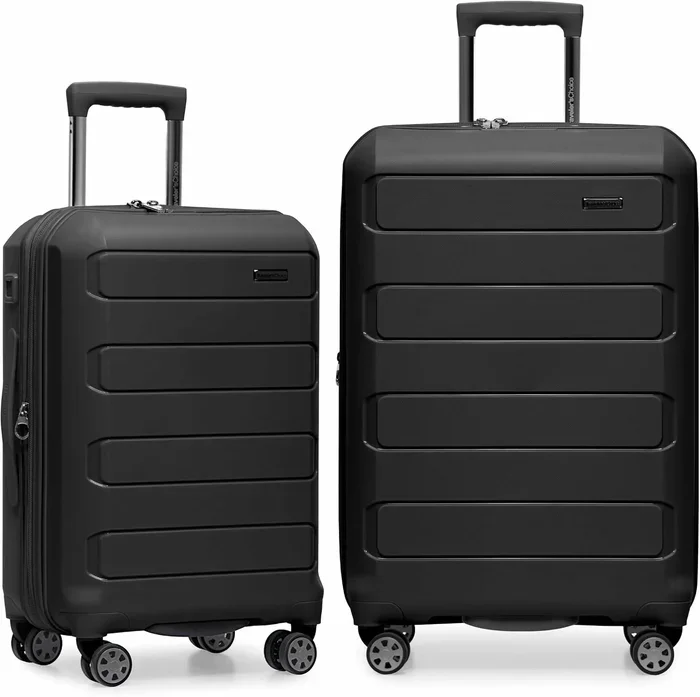
❌ Mistake: Buying the Biggest Set Available “Just in Case”
Why it’s bad: A 3-piece set with a 28-inch, 24-inch, and 20-inch sounds comprehensive. In reality, the 28-inch is often too heavy to lift when full (easily 60+ lbs), risking overweight fees or back injury. The 20-inch might not fit overhead bins on regional jets (which often require 22x14x9 or smaller). You end up using only the 24-inch.
What to do instead: Build a “capsule” set. For most: a 22-inch international carry-on (fits most global bins), a 25–26 inch medium check-in (the sweet spot for 2 weeks of clothes), and a personal item backpack. If you need a large check-in for family gear, buy a single 28-inch later.
❌ Mistake: Ignoring Interior Dimensions for Exterior Specs
Why it’s bad: Manufacturers advertise exterior dimensions (including wheels and handles) to meet airline limits. But the interior packing volume is what matters. A bag with thick corner guards, deep wheel wells, and a thick handle tube can lose 15-20% of usable space compared to a boxier design with the same exterior size.
What to do instead: Look for “interior dimensions” or “packing capacity in liters” in the specs. Read reviews where people measure the flat floor space. A flat-bottomed 25-inch bag often holds more than a tapered 26-inch bag.
❌ Mistake: Choosing Aesthetics Over Texture
Why it’s bad: High-gloss, mirror-finish shells look stunning in product photos. After one trip through baggage claim, they look like a scratched CD. Deep scratches on glossy finishes are highly visible. Matte or textured finishes (brushed, diamond-pattern, hexagonal) hide scuffs remarkably well.
What to do instead: If you check bags, prioritize matte, textured, or “anti-scratch” coated finishes. Save the glossy colors for carry-ons that stay with you.
❌ Mistake: Assuming “Spinner” Means “All-Terrain”
Why it’s bad: Standard 360 spinners are designed for smooth airport floors. Take them on cobblestones in Europe, gravel paths, or snowy sidewalks, and the small wheels clog, the housings crack, and the bearings seize.
What to do instead: If your travel involves rough ground, look for “off-road” or “all-terrain” spinners with larger (3.5″+), wider, rubber-treaded wheels (like Travelpro Platinum Elite or certain Thule models). Or accept that you will carry/drag the bag on rough patches and buy a durable inline two-wheel bag for those trips.
❌ Mistake: Overlooking the Personal Item / Backpack Integration
Why it’s bad: You buy a great 3-piece set but have no way to attach your laptop backpack to the carry-on handle. You end up carrying the backpack on one shoulder and pulling the spinner with the other—exhausting in a large terminal.
What to do instead: Check for a rear trolley sleeve (piggyback strap) on your backpack or tote. Better yet, some luggage sets (like Travelpro, Briggs & Riley, Samsonite) include a matching backpack or tote with a perfect-fit sleeve. If not, buy a backpack with a pass-through sleeve separately.
❌ Mistake: Skipping the “Shake Test” In-Store
Why it’s bad: Online shopping prevents this, but if you are in a store, skipping the physical test is a miss. A bag that feels solid on the shelf might have a handle that wobbles 2 inches side-to-side when extended, or wheels that spin freely for 2 seconds vs 10 seconds.
What to do instead: Extend the handle fully. Shake the bag gently side-to-side. Does the handle wobble? Roll it on the floor. Does it track straight or veer? Press on the shell corners. Do they flex alarmingly? Open the expansion zipper—does it glide or catch? These 30 seconds save years of annoyance.
❌ Mistake: Forgetting About Return Policies and “Open Box” Traps
Why it’s bad: You buy a set online, realize the 22-inch doesn’t fit your specific airline’s sizer, and try to return it. The retailer charges a 15% restocking fee plus return shipping on a 30-lb box. Or you buy “Open Box” to save 20%, but the expansion zipper is broken and the return window is 14 days with no warranty.
What to do instead: Buy from retailers with free returns (Amazon, Zappos, LL Bean, REI, direct brand sites). Keep all packaging for 2 weeks. Test fit your actual clothes. If buying open box, verify the warranty transfers (often it doesn’t) and inspect every zipper, wheel, and handle immediately.
Budget Guidelines: How Much Should You Spend?
Entry-Level ($100 – $180 for 3-Piece Set)
What you get: ABS or PC/ABS blend shells. Single-spinner wheels (often plastic hubs). Single-tube handles with 2 stops. Basic polyester interiors with X-straps only. 2-dial TSA locks or no locks. 1–2 year limited warranty (manufacturing defects only).
Reality check: These are disposable luggage. Expect 3–5 checked trips before a wheel fails, a handle bends, or a corner cracks. They are fine for: kids who grow fast, infrequent vacationers who carry-on only, or as a “beater” set for rough trips (camping gear, moving boxes). Do not buy these for frequent business travel or international checked bags.
Brands in this tier: Amazon Basics, Rockland, Merax, Coolife, American Tourister (entry lines), Kenneth Cole Reaction.
Mid-Range / Sweet Spot ($250 – $450 for 3-Piece Set)
What you get: 100% Polycarbonate (often Makrolon or Covestro). Double-spinner wheels with ball bearings (often Hinamoto). Double-tube handles with 3-4 stops. Ballistic nylon or high-denier polyester interiors with full dividers, compression panels, and multiple pockets. Recessed 3-dial TSA locks. 5–10 year or “Limited Lifetime” warranties with carry-in repair networks.
Reality check: This is where 90% of travelers should buy. These bags handle 5–10 trips per year for 5–8 years. The wheels survive cobblestones. The handles don’t wobble. The expansion zippers hold. You pay for engineering, not logo.
Brands in this tier: Travelpro (Platinum Elite, Maxlite 5), Samsonite (Freeform, Omni PC, Centric), Delsey (Chatelet Hard+, Helium Aero), Briggs & Riley (Baseline Domestic – often on sale), Eagle Creek (Calculated risk – lifetime warranty), Thule (Subterra, Crossover).
Premium ($500 – $900 for 3-Piece Set)
What you get: Premium grade polycarbonate (thicker, better finish). Proprietary wheel systems (silent run, wider stance). Ergonomic handles (leather-wrapped, wider grip). Luxury interiors: suede-feel lining, built-in garment folders, leather accents, removable laundry bags. Integrated USB ports (power bank not included) or AirTag slots. True lifetime warranties covering airline damage (Briggs & Riley, Tumi). White-glove repair service.
Reality check: You are paying for the “last 10% of perfection” and service. The mid-range bag does 90% of the job for 60% of the price. Buy premium if: you travel weekly, you check fragile gear, you value the repair convenience (walk-in service), or you want a bag that looks professional in a boardroom.
Brands in this tier: Briggs & Riley (Baseline, Torq), Tumi (19 Degree, Alpha 3), Samsonite (Proxis, Securipak), Rimowa (Essential Lite – polycarbonate), Victorinox (Spectra 3.0).
Luxury / Heirloom ($1,000+ per piece / $2,500+ for set)
What you get: Aluminum-magnesium alloys (Rimowa Original, Zero Halliburton) or carbon fiber / Tegris composites. Zero-zipper frame designs (latch closures). Hand-stitched leather handles. Serial numbered. Lifetime transferable warranties. Repair centers globally. High resale value (often 60-70% after 5 years).
Reality check: These are buy-it-for-life objects. They dent rather than crack (dents can be popped out). They are heavy (aluminum carry-on is 9-10 lbs empty). They are status symbols. If you have the budget and want the best engineering on earth, go here. If you want the best value, stay in Premium.
Expert Tips for Getting the Best Deal

Frequently Asked Questions
Q: Is polycarbonate really worth the extra money over ABS?
A: Yes, unequivocally, if you check bags. Polycarbonate’s flexibility allows it to absorb impacts that shatter ABS. I have seen ABS bags crack from a single drop onto a carousel. Polycarbonate bags survive years of baggage handling. If you only ever carry-on, ABS is acceptable since you control the handling. But the price gap has narrowed—many 100% PC sets are now under $250. Spend the extra $50.
Q: What does “Limited Lifetime Warranty” actually cover?
A: Read the fine print. Usually, it covers manufacturing defects in materials and workmanship (broken zipper pull, handle stuck out of box, wheel bearing seizure). It almost never covers: airline damage (crushed corners, torn wheels), cosmetic damage (scratches, dents), loss, or wear and tear. The exception is Briggs & Riley’s “Simple as That” warranty and Tumi’s 5-year warranty (which covers airline damage for the first 5 years). Most others require you to prove the defect wasn’t caused by “abuse”—and airlines are experts at abuse.
Q: Can I replace spinner wheels myself?
A: On many mid-range and premium bags, yes. Brands like Travelpro, Samsonite, and Briggs & Riley sell replacement wheel kits ($20-$40 per wheel) and provide video tutorials. You need a screwdriver (often Torx or Phillips) and 15 minutes. On budget riveted wheels, no—you cannot replace them without drilling out rivets and re-riveting, which requires tools and skill. This is a strong argument for buying a brand with replaceable wheels.
Q: How do I clean a hard shell suitcase?
A: Exterior: Warm water, mild dish soap, microfiber cloth. Avoid harsh chemicals, acetone, or magic erasers (they dull the finish). For scuff marks from other luggage, a dab of toothpaste (non-gel) or a melamine sponge gently rubbed can lift the transferred plastic/rubber. Interior: Vacuum debris. Spot clean liner with upholstery cleaner or diluted woolite. Air dry fully open before storing to prevent mildew.
Q: Are zipperless / frame-latch suitcases (like Rimowa Original) better?
A: They are structurally superior—no zipper to burst, jam, or be pried open with a pen. They are virtually waterproof. But: they are heavier (aluminum), expensive ($600+ per piece), and if the latch mechanism breaks, you can’t just yank it open; you need a locksmith or repair center. For 95% of travelers, a high-quality double-coil zipper (YKK RCW) on a polycarbonate shell is more practical.
Q: Should I buy a 2-piece or 3-piece set?
A: Depends on your household. Solo traveler: 2-piece (Carry-on + Medium Check-in) is perfect. Couple: 3-piece gives you each a carry-on and one shared large check-in. Family of 4: Two 3-piece sets (6 bags) or one 3-piece + individual carry-ons. Don’t buy pieces you won’t use just because “it’s a set.” Unused luggage degrades in storage (wheels flat-spot, lubricant dries).
Q: What’s the deal with built-in USB ports / battery packs?
A: The bag has a USB-A (or USB-C) port on the outside, wired to a pocket inside where you place your own power bank. The bag does not come with a battery (airline regulations). It’s convenient—you charge your phone while walking without digging for the battery. But the cable inside can fray, and the port cover breaks. It’s a nice-to-have, not a must-have. Prioritize shell and wheels first.
Q: How do I prevent my clothes from wrinkling in a hard shell?
A: Hard shells are actually better than softside for wrinkles if you pack right. The rigid walls prevent crushing. Use the compression panel/straps to lock clothes in place—shifting causes wrinkles. Roll casual clothes (t-shirts, jeans, knits). Fold structured items (blazers, dress shirts) flat in a garment folder or dry cleaner bag. Use packing cubes to create rigid modules. Fill dead space (shoes, corners) with socks/underwear to prevent shifting.
Q: Are there any expandable hard shells that expand inward instead of outward?
A: Rare. Almost all expand outward (increasing exterior dimensions). This matters because an expanded bag might not fit the airline sizer at the gate, even if it fit unexpanded. There are a few “internal expansion” designs (like some older Briggs & Riley models) where a floating panel drops down inside, but they reduce interior volume when not expanded. Assume expansion = larger exterior footprint.
Our Final Recommendations
Best for Budget-Conscious Buyers: Samsonite Freeform 3-Piece Set
You get 100% polycarbonate (rare at this price), double spinner wheels, a TSA lock, and a 10-year limited warranty. It often sells for $180-$220. The interior is basic but functional. It is the absolute floor for “buy it for life” quality. If your budget is hard-capped at $200, this is the one.
Best Overall Value (The Sweet Spot): Travelpro Platinum Elite 3-Piece Set
This is the bag airline pilots and flight attendants buy with their own money. Magnum 360 wheels (precision bearings, quiet, replaceable). PowerScope handle (contour grip, 4 stops, minimal wobble). High-resolution fabric interior with suiter, wet pocket, and accessory pockets. Lifetime warranty + “Trusted Companion Promise” (covers airline damage for 1 year). Price: ~$450-$550. Worth every penny.
Best Premium Option: Briggs & Riley Baseline Domestic 3-Piece Set
The “Simple as That” lifetime warranty covers airline damage forever. No receipt needed. CX expansion system (expands 25% but compresses back down with one hand—genius engineering). Ballistic nylon exterior pockets (rare on hard shell). YKK RCW zippers. It costs $700-$850, but it is the last set you will ever buy. Repair centers in major airports globally.
Best for Beginners / Infrequent Travelers: Delsey Paris Chatelet Hard+ 2-Piece Set
Gorgeous design (leather accents, brake system on wheels so it doesn’t roll away on train floors), 100% polycarbonate, very lightweight, silent double wheels. 10-year warranty. It feels premium but costs mid-range (~$350 for 2-piece). The brake feature alone saves frustration on transit. Great entry point to “nice” luggage.
Best for Advanced Users / Road Warriors: Tumi 19 Degree Aluminum / Polycarbonate Hybrid Set
If you live out of a suitcase 100+ nights a year. The 19 Degree shape isn’t just looks—it distributes impact forces. Hybrid construction: aluminum frame corners + polycarbonate panels = maximum protection, minimum weight. SRPP ballistic nylon interior. Tumi Tracer (lost bag recovery). 5-year warranty covering airline damage. Expensive ($1,500+ for set), but a tax-deductible business tool for many.
Conclusion: Making the Right Choice
You now know more about luggage construction than 99% of sales associates. You know that polycarbonate beats ABS, that double ball-bearing wheels beat single plastic spinners, that a recessed TSA lock beats a dangling padlock, and that a warranty you can walk into a store to use beats a “lifetime” warranty that requires a $50 shipping fee and a prayer.
Remember the priority order: Shell Material > Wheel/Handle System > Interior Organization > Warranty > Weight > Aesthetics. Do not let a pretty color or a “lightweight” claim override a brittle shell or wobbly handle. Your luggage works harder than almost anything else you own. It protects your professional wardrobe, your family’s vacation essentials, your electronics, and your peace of mind.
Invest in the tier that matches your travel frequency. If you fly twice a year, the Samsonite Freeform or Delsey Chatelet will serve you beautifully for a decade. If you fly twice a month, the Travelpro Platinum Elite or Briggs & Riley Baseline will pay for itself in saved replacements and stress-free connections. Buy the best you can reasonably afford, register the warranty, pack it smart, and travel well. The world is waiting—go meet it with a bag that’s ready for the journey.


