Packing for a trip used to feel like wrestling an octopus into a shoebox. You have your clothes, your shoes, your toiletries, and that weirdly shaped souvenir you just had to buy. Everything ends up a wrinkled mess, and finding a clean pair of socks requires an archaeological dig. That is exactly why compression packing cubes have become the secret weapon for everyone from weekend warriors to round-the-world travelers. They turn chaos into order, and more importantly, they shrink your gear down so you can actually close your suitcase without sitting on it.
But here is the catch: the market is flooded with options. You have got cubes with one zipper, cubes with two zippers, cubes made of nylon, cubes made of polyester, cubes that are water-resistant, and cubes that claim to be indestructible. If you have been staring at a screen full of “Gonex compression packing cubes expandable bags luggage organizers” and feeling your eyes glaze over, you are in the right place. This guide cuts through the marketing fluff. We are going to walk through exactly what matters, what is a waste of money, and how to pick the perfect set for your travel style.
By the time you finish reading, you will know the difference between a compression zipper and a standard zipper, why denier count matters more than thread count, and how to spot a durable cube that will survive baggage claim roulette. We will cover budget picks that punch above their weight, premium sets that last a decade, and the common mistakes that lead to buyer’s remorse. Let’s get your luggage organized once and for all.

What to Look for When Buying Buying Guide
1. Compression Mechanism: Single vs. Double Zipper
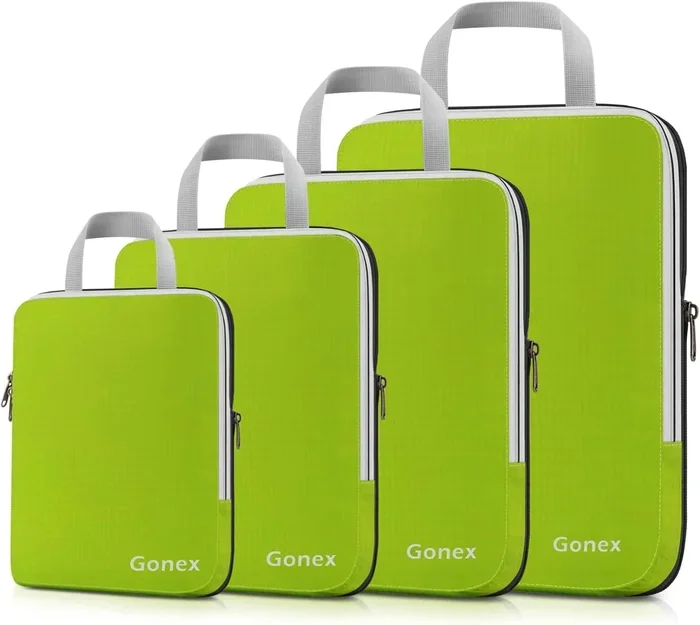
This is the single most important technical feature to understand. It is the engine of the whole system. Most packing cubes on the market are just stuff sacks with a single zipper around the perimeter. They organize, but they do not compress. True compression cubes feature two separate zipper tracks. The first zipper closes the cube like a normal bag. The second zipper, usually running parallel to the first, pulls the walls of the cube inward, squeezing the air out of your clothes.
Why does this matter? A single-zipper cube relies on you stuffing it full and mushing it down with your knee. A double-zipper cube does the work mechanically. You pack it, zip the inner perimeter, and then engage the outer compression zipper. You will visibly see the cube shrink by 30% to 50%. If you are trying to fit a week’s worth of clothes into a carry-on, this mechanism is non-negotiable. Look for zippers that run smoothly; a stuck compression zipper defeats the entire purpose.
2. Fabric Denier and Material Quality
You will see numbers like 30D, 40D, 70D, or even 150D thrown around in product descriptions. The “D” stands for Denier, a unit of measurement for the linear mass density of fibers. In plain English: it tells you how thick and tough the individual threads are. A higher number generally means a thicker, more abrasion-resistant fabric.
For compression cubes, you are typically looking at nylon or polyester. 30D to 40D nylon is the sweet spot for ultralight travel. It is featherlight, packs down tiny, and is surprisingly strong for its weight. 70D to 100D polyester or nylon is the standard for durability. It handles the stress of compression zippers pulling hard on the fabric seams much better over time. Anything above 150D is essentially ballistic nylon territory—bombproof but heavier. Avoid anything labeled just “polyester” without a denier rating; it is often thin, low-grade material that tears at the seams after a few trips.
3. Zipper Quality: YKK vs. Generic
The zipper is the failure point on 90% of cheap packing cubes. When you engage that compression zipper, you are putting massive lateral stress on the teeth. A cheap zipper will separate, jam, or lose teeth within a few trips. The gold standard is YKK zippers. You will see the little “YKK” stamp on the zipper pull. They are Japanese-engineered, self-lubricating, and virtually indestructible under normal travel loads.
If a product description does not explicitly mention YKK (or a comparable brand like SBS or IDEAL), assume they are generic no-name zippers. Also, look for double pulls on the compression zipper. This allows you to close the cube from the middle outward, distributing tension evenly. Single pulls on a long compression track often lead to the fabric puckering on one side.
4. Sizing Strategy and Set Configuration
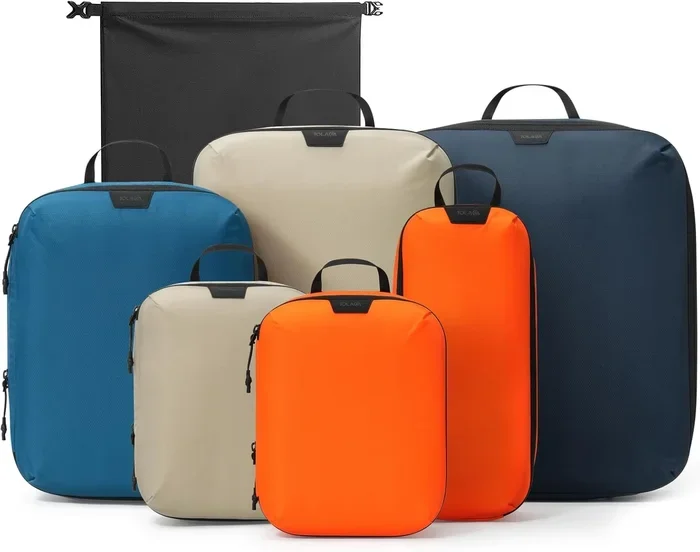
Do not just buy the “6-piece set” because it has the most pieces. You need a sizing strategy that matches your luggage. The industry standard sizes are roughly: Small (underwear, socks, tech cables), Medium (t-shirts, shorts, light sweaters), and Large (pants, jackets, bulky sweaters). Some brands offer an Extra Large or “Suit” size for dresses or suits.
Think about your packing style. Are you a roller or a folder? Rollers can fit more into a Medium cube. Folders might need a Large to keep dress shirts flat. A versatile starter set usually includes two Larges, two Mediums, and one Small. That covers a checked bag perfectly. For carry-on only travel, two Mediums and one Large is often the magic combo. Check the expanded vs. compressed dimensions listed by the manufacturer. A cube that expands to 18 inches long won’t fit in a 20-inch carry-on spine.
5. Structural Integrity: Framed vs. Soft-Sided
This is a design philosophy choice. Soft-sided cubes are just fabric boxes. They mold to the shape of your bag, filling every nook and cranny. They are lighter and pack flatter when empty. Framed or structured cubes have plastic stiffeners sewn into the side panels or a rigid bottom panel. They hold a perfect rectangular shape even when half-empty.
Framed cubes are fantastic for keeping dress shirts crisp and preventing the “crumpled ball” effect. They also stack like bricks in a suitcase, maximizing volume efficiency. However, they add weight (usually 2-4 ounces per cube) and they do not squish into odd-shaped gaps in a backpack. If you travel with a structured hardshell suitcase, framed cubes are a dream. If you live out of a soft duffel or backpack, soft-sided is the way to go.
6. Water Resistance and Cleanability
Spills happen. Shampoo caps pop off. Rain soaks your backpack during a transfer. A good packing cube acts as a first line of defense. Look for fabrics with a DWR (Durable Water Repellent) coating or a PU (polyurethane) backing. This causes water to bead up and roll off rather than soaking through to your clothes.
Equally important: can you wash them? Eventually, a cube will smell like dirty laundry or get a stain. High-quality nylon and polyester cubes can be tossed in a washing machine on a gentle cycle (air dry only—heat kills the waterproof coating and melts zipper pulls). Cheap cubes often have cardboard or paper stiffeners inside the walls that disintegrate when wet. Check the care label before buying.
7. Weight and Packability
Every ounce counts when you are chasing a 7kg carry-on limit on a budget airline. A set of six cubes can weigh anywhere from 8 ounces (ultralight 30D nylon) to 24 ounces (heavy structured polyester). That is a full pound of “dead weight” before you pack a single sock.
Also consider: how small does the set pack down when empty? If you are a one-bag traveler, you need to store your empty cubes inside your bag while you are wearing your clothes. Ultralight cubes stuff into a tiny pouch the size of a fist. Heavy structured cubes remain bulky rectangles. Weigh the trade-off: do you want maximum compression power (heavier cubes) or minimum weight penalty (ultralight cubes)?
8. Warranty and Brand Support
This is the “sleep well at night” factor. Brands like Gonex, Eagle Creek, Peak Design, and Osprey stand behind their gear with lifetime warranties or generous repair policies. A lifetime warranty on a $40 set of cubes signals that the manufacturer expects them to last decades. No-name brands on marketplace sites usually offer 30-day returns and then you are on your own.
Read the fine print. Does the warranty cover zipper failure? Seam separation? Fabric delamination? Or only “manufacturing defects” (which companies love to use to deny claims)? A responsive customer service team that sends replacement zippers or repairs a torn panel is worth paying a premium for. It turns a consumable product into a long-term travel companion.
Different Types of Buying Guide

Common Buying Mistakes to Avoid
❌ Mistake: Buying Only One Size
Why it’s bad: You end up stuffing socks into a Large cube (wasting space and compression efficiency) or trying to cram a winter coat into a Medium cube (stressing zippers and seams). Cubes work best when they are filled to 80-90% capacity before compression.
What to do instead: Buy a set with at least three distinct sizes. Use Small for “smalls” (underwear, socks, chargers), Medium for daily wear (t-shirts, pants), and Large for bulk (sweaters, jackets, jeans). If you travel solo, a 4-piece set (2M, 1L, 1S) is usually perfect.
❌ Mistake: Confusing “Packing Cubes” with “Compression Cubes”
Why it’s bad: Standard packing cubes organize but do not reduce volume. They have one zipper. If you buy these thinking they will save space, you will be disappointed. They are essentially fabric drawers.
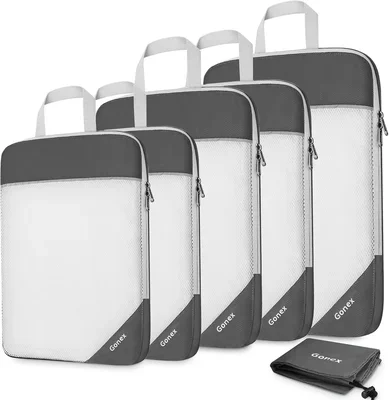
What to do instead: Look explicitly for the phrase “compression” and verify there are two zipper pulls on the main compartment. If the product photos only show one zipper track running around the perimeter, it is not a compression cube. The Gonex compression packing cubes expandable bags luggage organizers line, for example, clearly features the dual-zipper design.
❌ Mistake: Ignoring the “Expanded” Dimensions
Why it’s bad: You buy a Large cube that expands to 18″ x 13″ x 4″. Your carry-on interior is 17″ deep. The cube technically fits, but you cannot close the compression zipper because the cube is already pressing against the suitcase wall. You lose the compression benefit entirely.
What to do instead: Measure your suitcase’s interior dimensions (length, width, height). Subtract 1-2 inches from each dimension for wiggle room. Compare that to the cube’s expanded dimensions, not the compressed ones. You need room to operate the compression zipper.
❌ Mistake: Over-Compressing Delicate Fabrics
Why it’s bad: Compression works by removing air. Extreme pressure flattens fibers. Down jackets, merino wool, and structured blazers can lose loft, develop deep creases that never steam out, or have their insulation damaged permanently.
What to do instead: Use compression cubes for durable items: cotton, synthetics, denim, fleece, rolled t-shirts. Pack delicate items (blazers, down, silk) in a structured non-compression cube or a dedicated garment folder. Use the compression zipper gently—stop when you feel firm resistance, not when the zipper is straining.
❌ Mistake: Choosing Cubes Based Solely on Color/Aesthetics
Why it’s bad: That pretty pastel set with the mesh top panel might look great on Instagram, but the mesh tears on the first snag, the zippers are generic, and the fabric pills after two washes. You are buying a tool, not a decoration.
What to do instead: Prioritize specs: YKK zippers, denier rating, warranty, seam taping. Then pick the color you like from the qualified candidates. Color-coding is* useful for family travel (Blue=Dad, Pink=Mom, Green=Kid), but durability comes first.
❌ Mistake: Forgetting the “Empty Cube” Storage Problem
Why it’s bad: You arrive at your destination, unpack into drawers, and now you have six empty cubes taking up half your hotel closet or suitcase. Bulky structured cubes are the worst offenders here.
What to do instead: If you unpack fully at your destination, buy ultralight or soft-sided cubes that nest inside each other (Russian doll style) or stuff into a single small pouch. If you live out of your suitcase, structured cubes are fine because they stay full.
❌ Mistake: Skipping the Laundry/Dirty Cube
Why it’s bad: You mix dirty clothes with clean clothes because you don’t have a dedicated separator. By day three, your whole bag smells like a gym locker.
What to do instead: Dedicate one Small or Medium cube as the “Dirty” cube. Ideally, pick one with a mesh panel or a different color. Some sets include a specific laundry bag. If yours doesn’t, buy a separate lightweight stuff sack. It is the single best hygiene hack for multi-week trips.
Budget Guidelines: How Much Should You Spend?
Entry-Level ($15 – $30): The “Try Before You Commit” Zone
At this price, you are looking at generic brands, often sold in 6-8 piece sets. Expect 70D-100D polyester, generic zippers (rarely YKK), single-stitched seams, and thin mesh panels. The compression zipper will likely be a single pull, not double. They will compress your clothes. They will organize your bag. But the zippers may snag after 5-10 trips, seams may fray, and the fabric may tear if you overstuff aggressively.
Who should buy: First-time cube users wanting to test the concept, infrequent travelers (1-2 trips/year), kids’ luggage where durability matters less. If a zipper breaks, you are out $20, not $80.
Mid-Range ($30 – $55): The Sweet Spot for 90% of Travelers
This is where the Gonex compression packing cubes expandable bags luggage organizers typically live, alongside brands like Bagail, Bagsmart, and Shacke Pak. You get 70D-100D ripstop nylon or high-tenacity polyester, YKK or high-quality SBS zippers (often double-pull on compression), double-stitched or bar-tacked stress points, and water-resistant coatings. Sets usually include 4-6 pieces with a smart size distribution. Warranties range from 1 year to lifetime.
Who should buy: Regular travelers (3+ trips/year), carry-on only enthusiasts, families. This tier delivers 95% of the performance of premium cubes at 60% of the cost. The zippers will survive hundreds of cycles. The fabric handles airport conveyor belts.
Premium ($55 – $90): Buy It For Life Territory
Brands like Eagle Creek (Pack-It Reveal/Compression), Peak Design (Packing Cubes), and Osprey (UL Packing Cubes) dominate here. Materials are often proprietary: 40D-70D recycled nylon with advanced DWR, self-healing zippers (YKK AquaGuard), welded seams (no stitching to fail), and lifetime “no questions asked” warranties. The design details are obsessive: hypalon zipper pulls that don’t jingle, low-profile compression zippers that don’t snag on adjacent cubes, modular sizing that tessellates perfectly.
Who should buy: Full-time travelers, digital nomads, gear geeks, anyone who hates buying the same thing twice. If you travel 50+ nights a year, the cost-per-night makes these cheaper than replacing mid-range sets every 2-3 years.
Luxury ($90+): Specialized Systems
This includes complete travel systems like the Peak Design Travel Line (cubes + backpack + duffel integration) or custom leather/ballistic nylon sets. You are paying for ecosystem integration, brand prestige, and materials like 1680D ballistic nylon or VX21 X-Pac laminate. The cubes themselves are often similar to Premium tier but with proprietary attachment points (hooks, loops, magnets) that lock into a specific backpack or suitcase.
Who should buy: Professionals with a specific matching luggage ecosystem, travelers who value aesthetics and integration as much as function. Diminishing returns on pure compression performance are real here.
Expert Tips for Getting the Best Deal
- Watch for “Open Box” / “Warehouse Deals”: Major retailers (Amazon Warehouse, REI Used Gear, Backcountry Geartrade) sell returned cubes at 20-40% off. Since cubes have no electronics or moving parts beyond zippers, a returned set is usually indistinguishable from new. Check the return policy before buying.
- Buy Sets, Not Singles: Individual cubes cost $15-$25 each. A 4-piece set costs $35-$50. The per-cube savings are massive. Even if you don’t need the Small cube now, you will eventually (tech kit, toiletries, laundry).
- Check for “Bundle” Listings: Some brands sell a “Travel System” bundle: 3 compression cubes + a shoe bag + a toiletry bag + a laundry bag for a flat price. If you need the accessories anyway, the cubes end up nearly free.
- Leverage Lifetime Warranties: If you buy a Premium brand (Eagle Creek, Osprey, Peak Design) and a zipper fails in year 3, file a warranty claim. They often send a brand new replacement set. That effectively makes your cost $0 for the next decade.
- Ignore “Travel Organizer” Upsells: You do not need a separate “electronics organizer cube” if you have a Small packing cube. You do not need a “shoe cube” if you use a plastic grocery bag or a dedicated shoe bag ($5). The core compression cubes do 90% of the work.
- Read 2-Star and 3-Star Reviews: 5-star reviews are often “just got them, look cute.” 1-star reviews are often “wrong size shipped.” The 2-3 star reviews from verified purchasers after 6 months of use tell you the truth about zipper durability, seam failure, and fabric pilling.
- Test Fit at Home: When your cubes arrive, load them up with your actual clothes. Put them in your actual suitcase. Practice the compression zipper. If they don’t fit your bag or the zipper fights you, return them immediately. Do not discover this at the airport.
Frequently Asked Questions
Q: Do compression packing cubes actually save space, or just organize?
A: They genuinely save space. The mechanical compression zipper physically reduces the volume of soft goods (clothes) by 30-50% by removing air gaps between fibers. It is not magic—you cannot compress a rock—but for a typical clothing load, you fit significantly more in the same suitcase. Organization is the bonus; volume reduction is the feature.
Q: Will compression cubes wrinkle my clothes?
A: They can, if you over-compress or pack poorly. The trick: fold clothes neatly (or roll tightly) before placing them in the cube. Do not just stuff them in. Engage the compression zipper slowly. Stop when you feel firm resistance. Clothes packed flat and compressed moderately arrive far less wrinkled than clothes jammed loosely into a suitcase where they shift and crumple during transit.
Q: Are Gonex compression packing cubes expandable bags luggage organizers worth the money?
A: Yes, they sit firmly in the Mid-Range sweet spot. They typically use 70D-100D nylon, YKK or SBS zippers, double stitching, and offer a lifetime warranty on many listings. They provide 90% of the performance of $80 brands for $35-$45. They are a very safe, high-value purchase for almost any traveler.
Q: Can I wash packing cubes in the washing machine?
A: Most nylon/polyester cubes: Yes, gentle cycle, cold water, mild detergent. Air dry only. Do not put them in the dryer. Heat damages waterproof coatings, melts zipper pulls, and can shrink fabrics unevenly. Check for internal stiffeners (cardboard/plastic) — if present, hand wash only. When in doubt, hand wash in a sink with soap and hang to dry.
Q: What is the difference between “expansion” and “compression”?
A: Compression makes the cube smaller than its “resting” size (squeezes air out). Expansion makes the cube larger than its resting size (usually via a gusset or expansion zipper that adds 2-3 inches of depth). Some cubes do both: they compress down for the outbound trip and expand up for the return trip (souvenirs, dirty laundry). This is a distinct feature from standard compression.
Q: How many cubes do I need for a carry-on only trip?
A: For a standard 22″ carry-on (40-45L): Two Medium cubes + One Large cube is the classic “Golden Triangle.” This fills the main compartment perfectly. Add a Small cube for underwear/tech if you have a front pocket or extra depth. If you use a 30L backpack, two Mediums is usually the limit.
Q: Do I need a separate shoe bag?
A: Not strictly. A Medium compression cube fits one pair of shoes (soles together, heel-to-toe) with room for socks stuffed inside the shoes. However, shoes are dirty and oddly shaped. A dedicated shoe bag ($8-$15) keeps dirt off your cubes and maintains the cube’s rectangular stacking shape. It is a cheap luxury worth having.
Q: Can I use compression cubes in a backpack?
A: Absolutely. Soft-sided compression cubes are excellent for backpacks. They turn a cavernous main compartment into organized “drawers.” You can pull out the “Shirts” cube to get a shirt without dumping the whole bag. Structured cubes are less ideal for backpacks because they don’t conform to the curved back panel.
Q: What does “ripstop” fabric mean?
A: Ripstop is a weaving technique where thicker reinforcement threads are interwoven at regular intervals in a crosshatch pattern. If a tear starts, it hits the thicker thread and stops spreading. It does not mean “tear-proof.” It means a snag on a zipper or a branch won’t turn into a giant hole. It is a hallmark of quality outdoor gear.
Q: Are packing cubes TSA approved?
A: There is no such thing as “TSA approved” for packing cubes. TSA approves locks and liquids bags. Cubes are just fabric containers. However, they help with TSA: if an agent needs to inspect your bag, they can lift out whole cubes instead of pawing through loose clothes. It speeds up the process and keeps your stuff private.
Our Final Recommendations
Best for Budget-Conscious Buyers: Gonex 6-Piece Compression Packing Cubes Set
You get six pieces (usually 2L, 2M, 1S, 1 XS/flat) for under $30. They use 70D nylon, SBS zippers (reliable), and have the double-zipper compression. The mesh tops are decent quality. The warranty is usually 1-year but customer service is responsive. Perfect for a family vacation or someone trying cubes for the first time without a big investment.
Best Overall Value: Gonex 4-Piece Premium Compression Set (or Bagail/Shacke Pak equivalents)
In the $35-$45 range, this is the set I recommend to friends. Four pieces (2L, 1M, 1S) hits the sizing sweet spot for solo travelers. The fabric is often upgraded to 100D ripstop nylon, zippers are YKK, seams are bar-tacked. They compress aggressively, stack beautifully, and take a beating. Lifetime warranty on most listings. This is the “buy once, cry once” sweet spot.
Best Premium Option: Eagle Creek Pack-It Reveal Compression Cube Set
If budget is not the constraint, this is the benchmark. The fabric is a proprietary translucent 40D ripstop (you can see contents), zippers are YKK AquaGuard (water-resistant), and the compression zipper is a low-profile design that doesn’t add bulk. The lifetime warranty is legendary—people get 15-year-old cubes replaced. They are pricey ($60-$75 for 3 cubes), but they are the last cubes you will ever buy.
Best for Beginners: Bagsmart 6-Piece Compression Packing Cubes
Bagsmart focuses heavily on user experience. Their cubes often have a “quick grab” handle on the side (not just the top), color-coded internal liners (so you know which cube is which in a dark hotel room), and a very smooth compression action. The included laundry bag and shoe bag are actually usable quality. The instruction card explains the folding method. It holds your hand through the learning curve.
Best for Advanced Users / One-Bag Travelers: Peak Design Packing Cubes (FlexFold)
These are different. They are structured (origami-style fold-flat design), made of 70D recycled nylon canvas with 1680D ballistic nylon bottom panels. They have internal dividers, magnetic closure flaps, and external zippered pockets. They integrate magnetically into Peak Design travel backpacks. They are expensive ($80+ for a set), heavy for their volume, but they keep a suit crisp and a backpack organized like a mobile office. For the digital nomad living out of a 35L pack, they are unmatched.
Conclusion: Making the Right Choice
We have covered a lot of ground. From the mechanics of double zippers to the nuances of denier ratings, from the $20 starter sets to the $80 lifetime systems. The core truth is simple: any compression cube is better than no compression cube. Even the cheapest set will organize your suitcase and save you some space. But the right set—matched to your luggage, your packing style, and your travel frequency—will change how you travel. It removes the friction. It turns packing from a dreaded chore into a 10-minute routine.
Start with your luggage. Measure it. Decide if you need structured shapes for a hardshell or soft flexibility for a backpack. Pick a size set that fills your bag efficiently (Large + Medium + Small). Prioritize YKK zippers and a denier rating above 70D. Spend $35-$45 for the Mid-Range sweet spot unless you travel constantly, in which case the Premium lifetime warranty pays for itself.
Do not overthink the brand name on the label. Focus on the specs we discussed. Read those 3-star reviews. Test the fit at home. And most importantly—go somewhere. The best packing cubes are the ones currently holding your clothes in a hotel room in a city you have never visited. That is where they prove their worth. Happy travels, and enjoy that extra space in your carry-on.